On a bridge or viaduct, what is at stake is the safety of those crossing it and the responsibility of those who manage it. Italy's bridge guidelines have made knowledge of a structure's condition a documentary obligation, and continuous monitoring meets that obligation while delivering a management advantage: it catches degradation early, directs maintenance where it is needed and reduces closures and emergency works. To visual inspection, BBOX 2.0 adds the real behaviour of the structure, measured continuously and interpreted in a signed report.
Continuous monitoring completes the picture of the structure
An inspection provides a snapshot: how the bridge was on that day, from what could be seen. It is a necessary element, and continuous structural monitoring extends its reach by filling the space between one inspection and the next with measurements. A structure works every hour under traffic, thermal cycles, erosion and settlement: continuous measurements show how it behaves, as well as how it looks.
The practical advantages follow. Degradation is caught while intervening is still cheap. Maintenance concentrates where it is needed instead of spreading out as a precaution. And across a portfolio of structures, priorities are set on data rather than impressions, which is the biggest step forward for anyone managing dozens of bridges on a finite budget.
Where the Class of Attention is high, surveillance is required
Italy's guidelines on the classification and risk management of existing bridges, adopted with Ministerial Decree 578/2020 and updated by Decree 204/2022, organise the management of structures by Classes of Attention. For the higher classes, the prescribed process includes further investigation and surveillance activities, and continuous structural monitoring provides the measurements on which to base them.
Continuous surveillance and event response on the same installation
One hardware setup covers two needs: knowing the structure over time and knowing how it responded to an event.
The structure followed over time
Continuous measurements that make the evolution of behaviour readable, with the effect of temperature compensated for.
Changes in dynamic characteristics, natural frequencies and mode shapes, and in inclinations, read continuously with temperature compensation to separate real degradation from seasonal fluctuation.
Objective data that complements periodic inspections and directs their priorities.
The response to the event, measured
After an earthquake or an exceptional event, the recorded response of the structure in usable form.
Accelerations and displacements recorded during the event give the managing authority the technical basis to decide promptly on any restrictions or closures to traffic.
The recorded data indicates which elements to focus inspections and investigations on, and remains as technical documentation of the event.
On a bridge the instrumentation is almost always heterogeneous, and that is an advantage: the BBOX 2.0 datalogger accepts several types of sensor, bringing instruments already in place or to be added into a single data stream.
How structural monitoring works →A signed report to base decisions on
Monitoring ends with a report interpreted and signed by a structural engineer, which takes two forms.
The periodic SHM report documents the evolution of the structure's condition with reliable data and, as the years pass, becomes its technical history: an element supporting the diligence of those who manage it.
The post-event report sets out the measured response of the structure and gives the managing authority the technical basis for decisions on traffic.
In service on road infrastructure
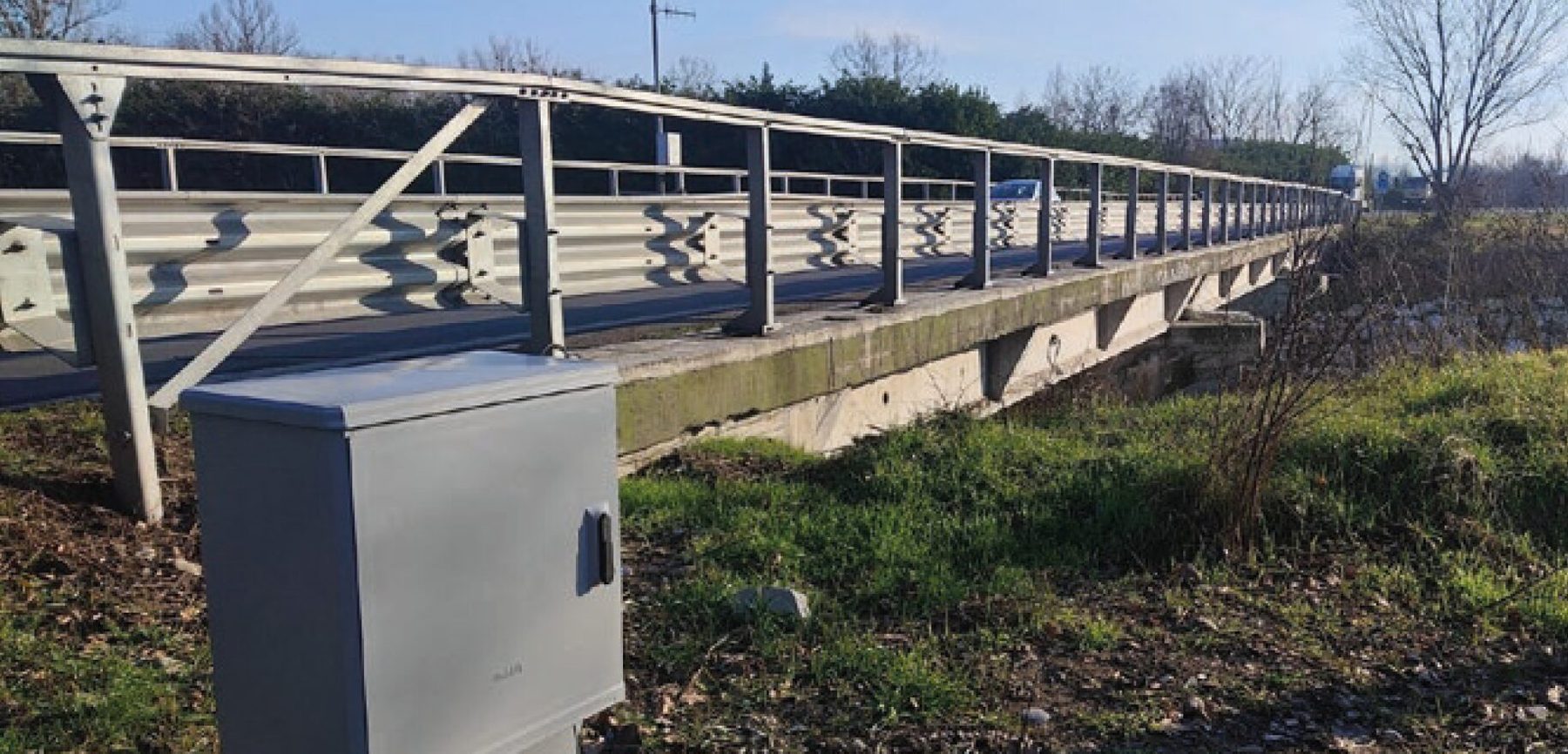
Representative installations include the Rubiera bridge over the Secchia river: a strategic structure subject to heavy vehicular traffic and natural erosion, where 10 accelerometer sensors acquire data continuously over the mobile network and support periodic inspections with objective information on how structural conditions evolve.
Manage the risk of your infrastructure
The MOSI team is available for tailored technical advice.
Request a consultationContinue reading
- How continuous structural monitoring works: SHM and post-event monitoring
- BBOX 2.0: sensors, datalogger and the consultation platform
- BBOX 2.0 installations on buildings, bridges and heritage sites
- Frequently asked questions on structural monitoring
- MOSI Srl: who we are and why we build monitoring systems
- Insights on regulation and the condition of the built environment