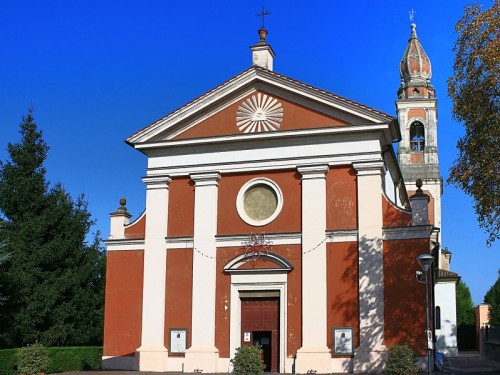
On a historic building, what is at stake is the safety of those who live in it, visit it or work there, and the conservation of heritage that cannot be replaced. These are structures built without seismic criteria, altered over the centuries and often still in use, where degradation advances slowly and without evident signs. BBOX 2.0 makes it measurable and turns the measurement into a report signed by a structural engineer.
Conservation guided by data, before the damage becomes visible
Historic palaces, churches, theatres, museums, towers and bell towers, listed buildings used as offices or schools: different contexts, the same underlying condition. Rotations, settlement and material decay progress at a pace that a periodic inspection struggles to quantify: the crack is visible, and how fast it is advancing remains to be established.
On protected buildings every intervention has to be justified to the heritage authorities, and arriving with measured evidence rather than an impression changes the conversation. Continuous structural monitoring makes conservation a process informed by data.
Monitoring among the tools for understanding the building
The Directive of the President of the Council of Ministers of 9 February 2011, which sets out the guidelines for assessing and reducing seismic risk for cultural heritage, recognises monitoring among the tools for tracking how structural damage evolves and for planning conservation work. Continuous measurements document that evolution with data that remains on record.
One installation for conservation and for the earthquake
One hardware setup covers two needs: following the building day by day and knowing how it reacted to an earthquake.
Inclination and behaviour followed over time
On slender structures inclination is the first indicator, and comparing the building against its own history replaces reference to an abstract model.
On towers, bell towers and slender structures, inclination is provided by the base configuration itself, and how it evolves over time is the first indicator of settlement in progress.
Changes in dynamic characteristics signal degradation, with temperature compensation separating real movement from thermal fluctuations, which are significant on historic masonry.
The datalogger accepts several types of sensor: advanced inclinometers, crack gauges, strain gauges, distance meters and environmental sensors.
How the building reacted to the earthquake
The response recorded during the tremor, available when quick decisions are needed.
During a tremor the system records the real response of the structure, and that data supports a timely assessment of its condition and of the priorities for making it safe.
The recorded data indicates which parts to focus inspections and safety works on, and constitutes technical documentation of the event to present to the heritage authorities.
One hardware setup covers two needs: following the building day by day and knowing how it reacted to an earthquake.
How structural monitoring works →A signed report to base conservation decisions on
What reaches the desk of those who decide is a report interpreted and signed by a structural engineer, in two forms.
The periodic SHM report documents the evolution of the building's condition with reliable data and gives heritage authorities and conservation plans objective evidence on which to base their decisions.
The post-event report captures the condition of the building after an earthquake and sets out the measured response of the structure, with the elements needed to establish priorities for making it safe.
In service on protected heritage buildings
Representative installations include the bell tower of the church of San Nicola di Bari in Camposanto, in the province of Modena: a sixteenth-century building severely damaged by the 2012 Emilia-Romagna earthquake and restored in 2016. Four accelerometer sensors follow its inclination over time and detect its seismic response, providing objective technical data in support of preventive conservation.
Protect your heritage building with data
The MOSI team is available for tailored technical advice.
Request a consultationContinue reading
- How continuous structural monitoring works: SHM and post-event monitoring
- BBOX 2.0: sensors, datalogger and the consultation platform
- BBOX 2.0 installations on buildings, bridges and heritage sites
- Frequently asked questions on structural monitoring
- MOSI Srl: who we are and why we build monitoring systems
- Insights on regulation and the condition of the built environment