A hospital, a civil protection facility or a public utility plant have to stay operational at precisely the moment when everything else stops. Here what is at stake is collective safety and the continuity of an essential function. BBOX 2.0 answers with measured data and a report signed by a structural engineer.
Operational capacity matters most right after the earthquake
Critical infrastructure delivers services that have to remain available at critical moments, and it is after an earthquake that their operational capacity matters most. Continuous structural monitoring places the decision on service continuity on real measurements.
The difference is measured in hours: how long passes between the tremor and the moment someone can say, with a document in hand, whether the service can carry on.
The resilience of critical entities has become a European matter
Directive (EU) 2022/2557 on the resilience of critical entities, transposed in Italy by Legislative Decree no. 134 of 4 September 2024, covers eleven sectors including health, energy, transport, drinking water and public administration. It requires entities identified as critical to assess their own risks, natural disasters included, and to adopt adequate measures to keep operating or restore service quickly after an incident. Continuous structural monitoring provides the measured evidence on which to base those measures and to document how they hold up over time.
One installation for the immediate decision and for verification over time
One hardware setup covers two needs: deciding immediately after the event and documenting condition over time.
Service continuity decided on measurements
After the event, the recorded response of the structure in the hours when the service has to be guaranteed.
After an event, the measured response makes it possible to assess quickly whether the structure can continue to operate.
The data focuses inspections and repairs where they are needed, keeping an essential function running.
The resilience of the asset documented
Behaviour followed over time becomes verifiable evidence of how the structure holds up.
Behaviour followed over time builds verifiable evidence of the asset's resilience, useful when that resilience has to be demonstrated to an authority.
On structures fitted with base isolators or other seismic devices, continuous measurements track device behaviour over time, and when an event occurs the comparison of accelerations across the isolation plane quantifies their dissipative efficiency.
A signed report to decide on service continuity
Monitoring ends with a report interpreted and signed by a structural engineer, in two forms.
The post-event report sets out the measured response of the structure and provides the technical basis for the decision on the continuity of the critical function.
The periodic SHM report documents the condition and resilience of the infrastructure over time with reliable data and supports the planning of inspections and works.
In service on healthcare and emergency infrastructure
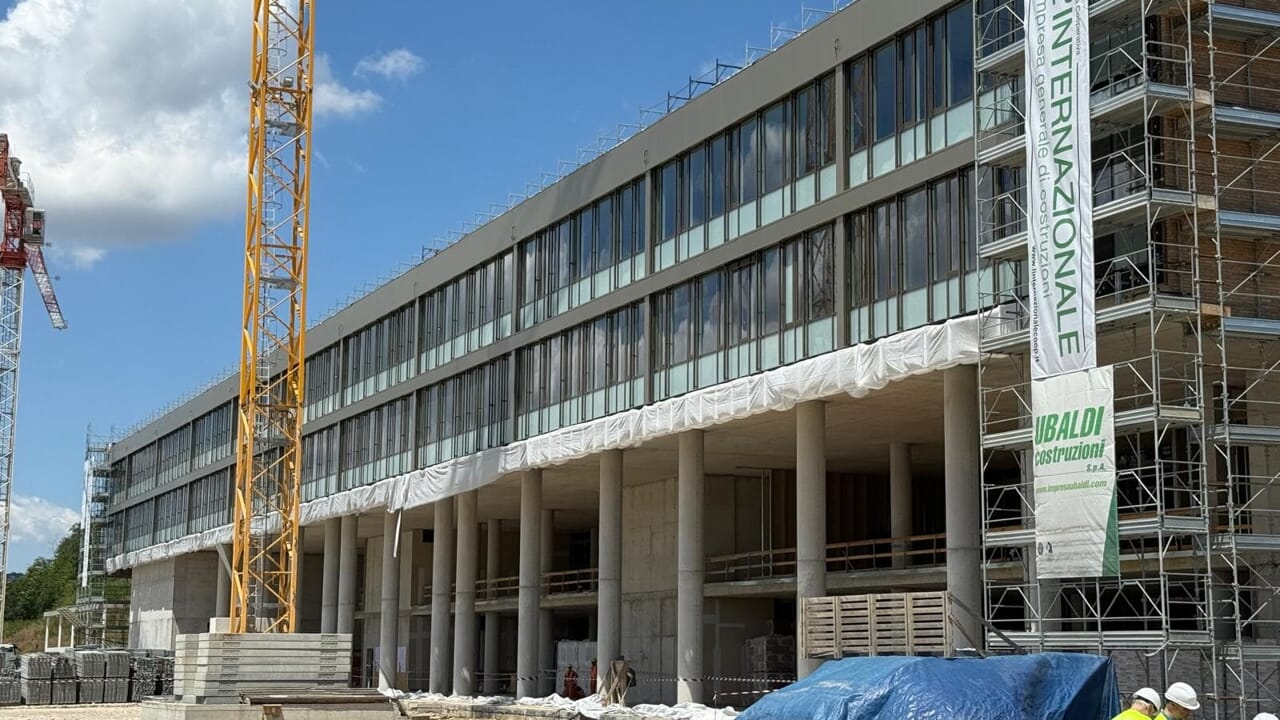
Representative installations include the new INRCA hospital in Camerano: a building under construction fitted with base isolators, where 32 sensors track their behaviour over time and, when an event occurs, verify their dissipative efficiency by comparing accelerations above and below the isolation plane, safeguarding operational continuity in one of the most critical buildings in the area. Sixteen sensors also monitor the Italian Red Cross facility in Scandiano, an essential base for local emergency services.
Frequently asked questions on monitoring seismically isolated structuresProtect the continuity of your infrastructure
The MOSI team is available for tailored technical advice.
Request a consultationContinue reading
- How continuous structural monitoring works: SHM and post-event monitoring
- BBOX 2.0: sensors, datalogger and the consultation platform
- BBOX 2.0 installations on buildings, bridges and heritage sites
- Frequently asked questions on structural monitoring
- MOSI Srl: who we are and why we build monitoring systems
- Insights on regulation and the condition of the built environment